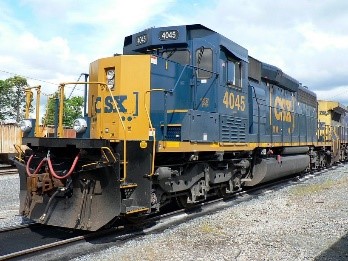
In my last post, I introduced you to this project and the modifications that were done on the chassis. In this post, I will highlight the modifications that were done to the shell.
As I am writing this series, I am slowly realizing that I could have done a much better job at recording some of the smaller yet still important details (drill bit sizes, adhesive types, etc.). With that being said, I will try my best to provide as much info as I can recall; but, in future series, I’ll be sure to be a little more meticulous.
Now . . . on with the show!
Shell Modifications
Before any work could begin on the shell, I gave it a bath in 91% alcohol. On Athearn models, 91% alcohol is my go-to for factory paint and decal removal. it does not damage the plastic and does a fairly good job at getting all of the paint off of the model.
There are quite a few things that have to happen to the Athearn ready-to-run shell in order for it to take on its new persona as the Sponge Bob SD40-3. Not pictured, but very much necessary, I removed the factory-molded pilot details from both ends of the shell. This process included shaving off the dimples for the MU lines and cutting of the brackets for the coupler lift bars. With the factory details removed, I pre-drilled holes for the after-market detail parts (I like to use Details West 3-cluster MU cables (235-266) and air hoses (235-267); and, Cal Scale coupler lift bars (190-522)).
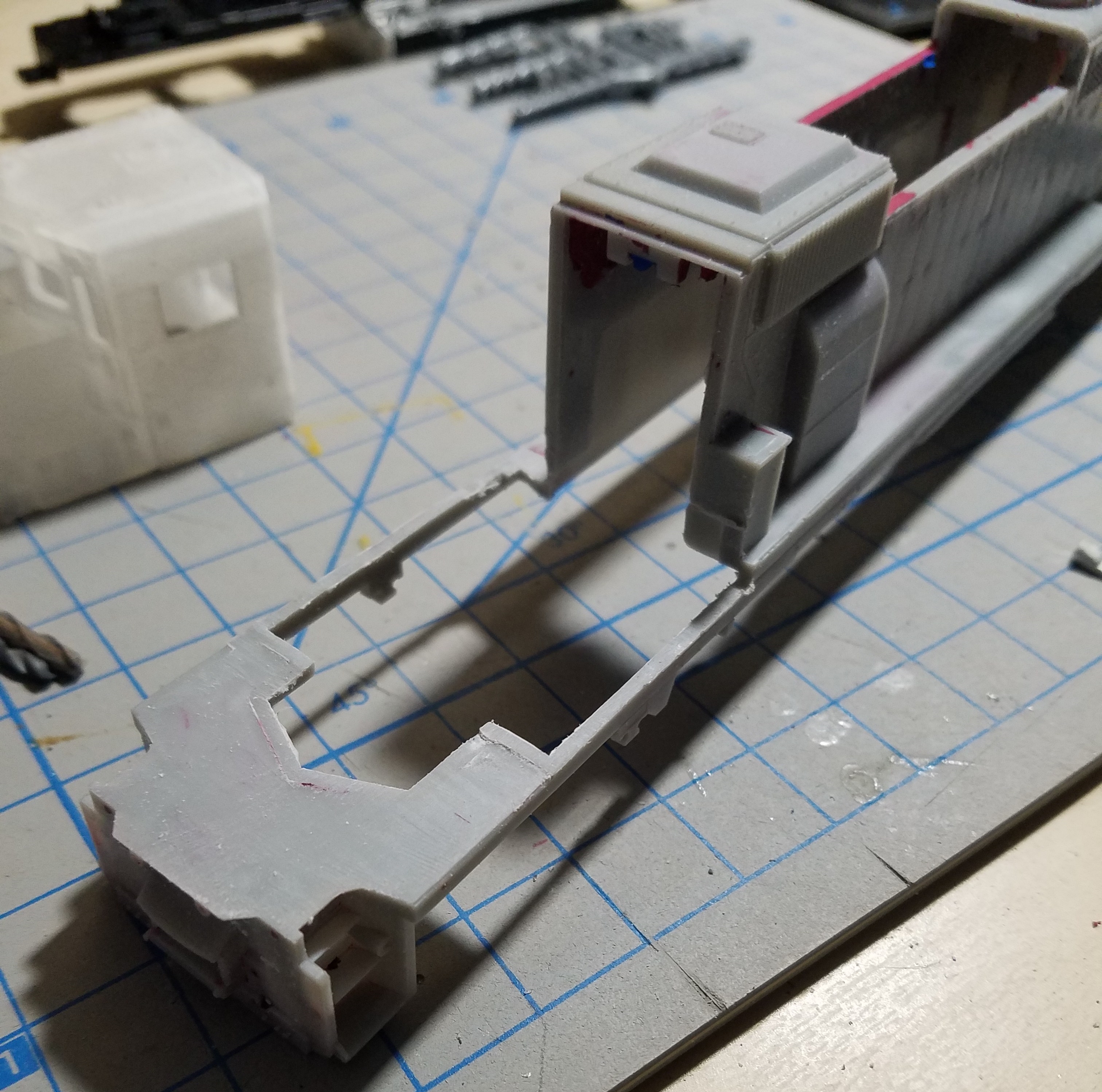
After I removed all of the pilot details, I had to make way for the Shapeway’s Wabtech cab. So, taking my handy Dremel tool, I carefully began to cut into the sub-base in order to separate it from the shell. Cutting into plastic with a Dremel can get very messy and cause a lot of damage; so, I had to take care to cut only so much with it. I got down to around 1/8th of inch from the base and decided to use my X-Acto to cut the rest. I carefully cut and chiseled until I was nearly flush with the shell base and then I used a combination of files and sandpaper to finish it off.
In the picture below, you can see that, even with the X-Acto, I could not avoid some small nicks and cuts. Thank goodness for green putty!
While I was in a cutting mood, I decided to cut out the molded radiator fans (I also cut out the dynamic brake fans on an extended range SD40-2 dynamic brake blister that I cannibalized from another model). In order to cut out the fans, I used a 7/16″ spade drill bit to bore out each fan. I went behind that with my Dremel tool on a slow setting and a grinding bit to clean the holes out. I still needed to use my X-Acto blades for some close quarters work; however, patience and a steady hand made for some pretty clean cuts. 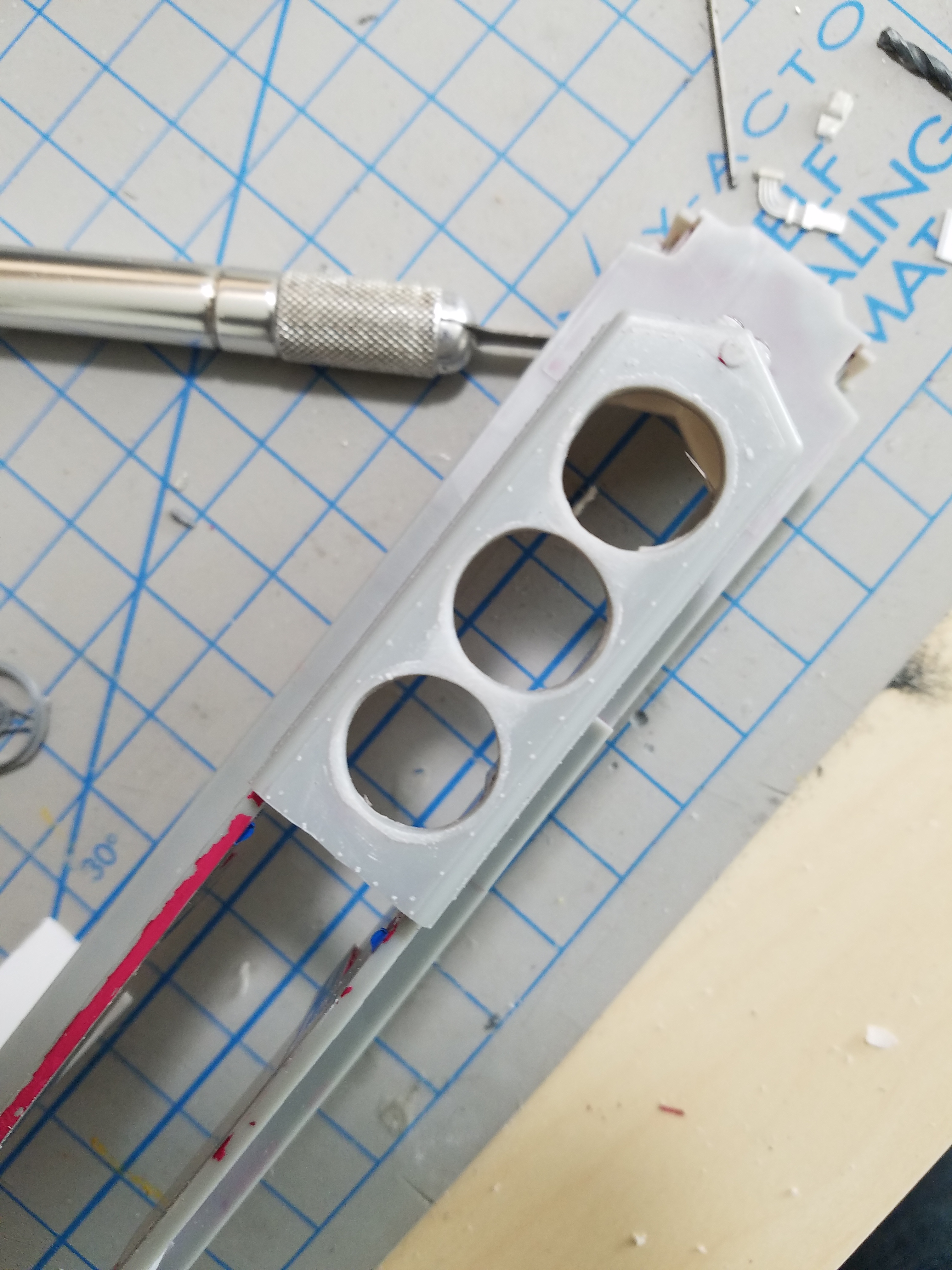
In the picture above, you can see where I used some sand paper to remove the remaining flash from the shell and smooth out the surface. I tried my best to not sand off the molded bolt dimples (I don’t think I did too bad).
The holes were a little small initially; but, that’s okay . . . I’d rather them be small and have to bore them out a little than for them to be too big. So using the fan bases as guides, I used my X-Acto blade to carve out the holes until each base just fit in the appropriate hole as seen in the picture below.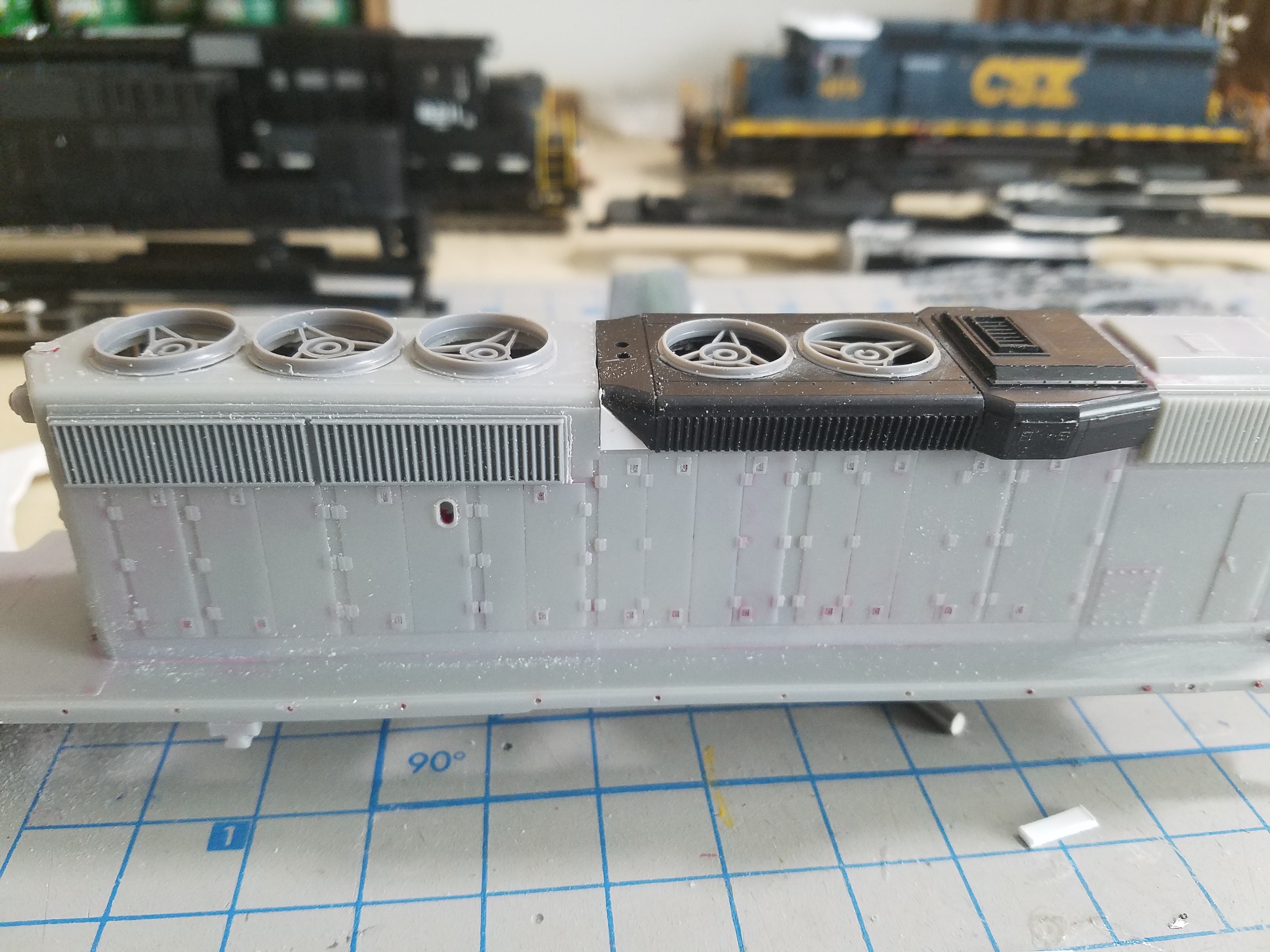
Before you ask, yes this picture is out of sequence; however, I wanted you to see how the fan bases fit into the holes after I cut them to size. Also, I broke the back corner of the dynamic brake blister when I was drilling out the fans; so, I had to use a piece of styrene to repair it. As for the radiator grills, read on . . .
The as-molded radiator grills on the Athearn model didn’t match the prototype photos or the grills on my Scaletrains model; so, I dug into my parts bin and found the correct radiator grills made by Cannon and Company (191-1403). To install these, the first thing I did was to cut out the original grills with, you guessed it, my Dremel tool. 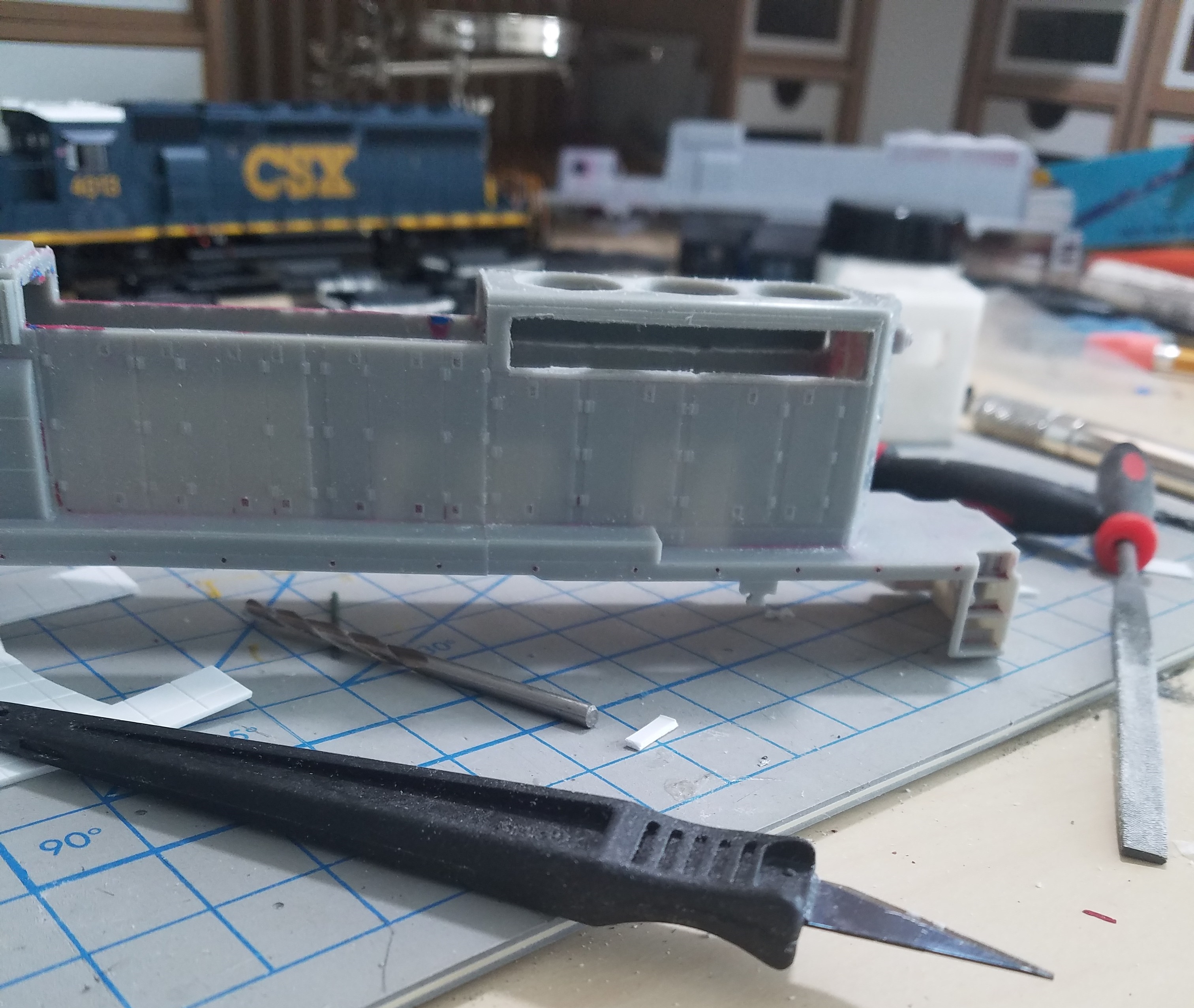
Okay, so the process was a little more involved than just taking my Dremel to the grills. As evidenced by the photo, I started by drilling a series of holes with the drill bit that you can see resting under the shell. Once I had all of the holes drilled, I took my heavy duty cutting blade and “connected the dots” by making an incision between each of the holes. With that done, I could then push out the plastic and then I used the Dremel to clean up the resulting opening.
With the openings cut and cleaned, I sanded the surface of the shell to lower a slightly raised surface so that it would be flush with the rest of the shell (not sure why Athearn has this raised surface; but, if I didn’t sand it down, the grills would stick out too much). Now that the surface was flush, I could add the Cannon and Company replacements (go back to the photo that was out of sequence).
In the next post, I will go over the details that I added to the pilots along with the underframe modifications as well. Until then, I hope you enjoy!!

 MDRAIL