Anyone who knows anything about me and my modeling endeavors knows that I have a tendency to flip-flop on design quite a bit. With the construction of a new home pending, my pattern for creating multiple designs continues as strong as ever. But it is thanks to the loving and gentle nudging of my wife that I am finally settled on what I believe is the best layout option for the space provided. . .
My Wish List vs. Practical Functionality
My new layout space will be 21’6” x 15’6” in an upper level bonus room of the new house. There are no poles, posts or other obstructions to consider in the space; but, here is the caveat: the room also has to serve as my office and recording studio in addition to my dream layout room.
Coming from a 6’ x 12’ design that I began constructing in my rental home, having a space as large as the new layout room is like the feeling you get as a kid waking up on Christmas morning! My brain went into overdrive and I created maybe five versions of plans that would utilize every inch of available wall space. Unfortunately, none of these ideas took into account the fact that I need somewhere to put a desk and access to the small closet which will be used as a vocal booth. As fun as it was to come up with those plans and even plan out the scenery, it took the counsel of a good friend to bring me down out of the clouds.
Based on his advice, I took a practical approach to planning the layout. I started with a list of negotiables and non-negotiables (commonly referred to as ‘given and druthers’ in the modelling world).
Not up for negotiation:
- I have to leave an area for my desk.
- I have to leave access to the closet/vocal booth.
- The scenicked portion of the layout has to be on one level (staging beneath is acceptable).
My wish list:
- Modern era theme which can accommodate big diesels (i.e., SD70CAe’s, etc.).
- Reasonable mainline run with adequate passing siding to hold long trains.
- Easily accessible without duck-unders or track work out of normal arms reach.
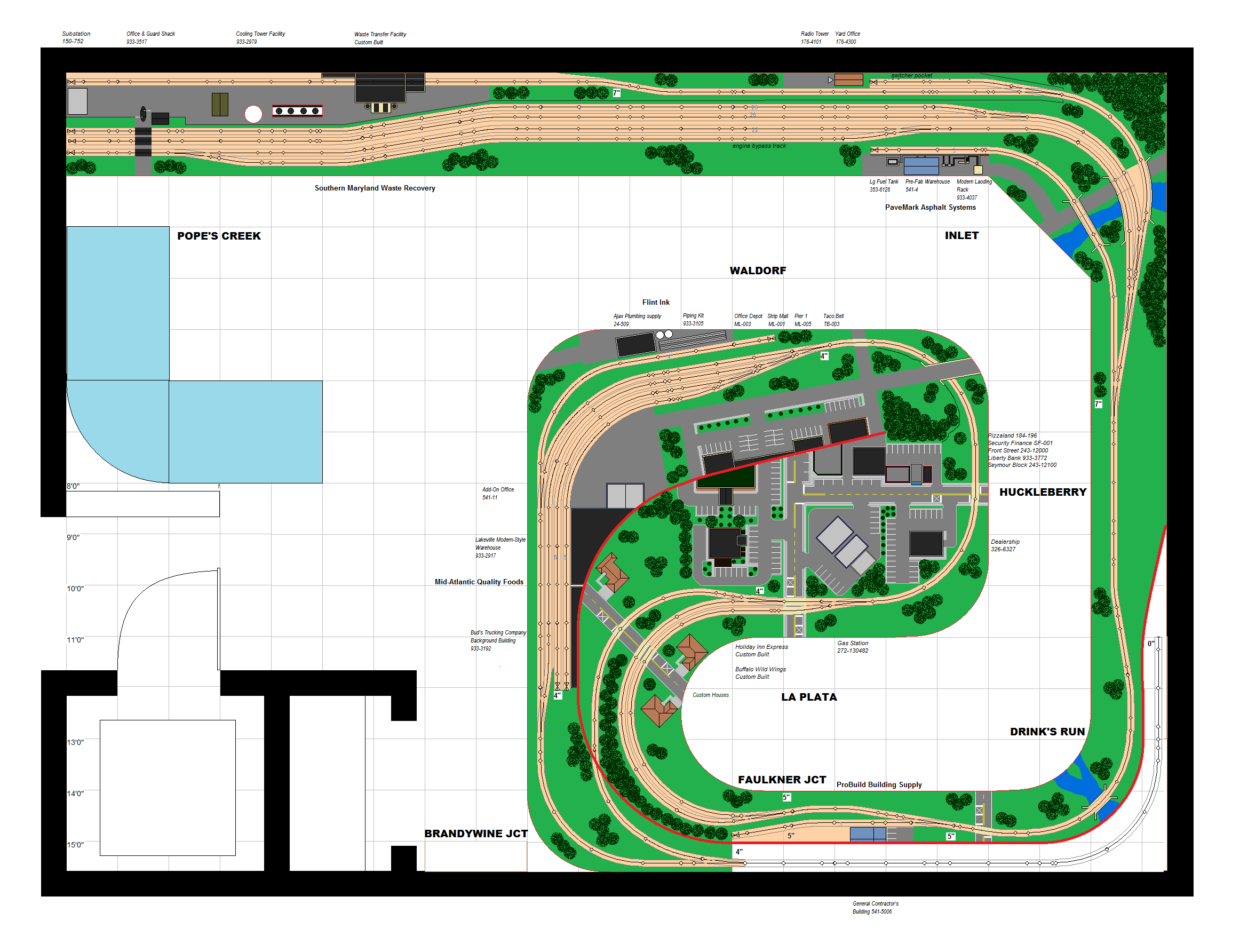
With those things in mind, I kept getting drawn back to an idea that I first saw in the 1997 edition of Model Railroad Planning: Big Blue in a Bedroom. I have been eyeing this layout idea for the last 18 years because it just feels right. I just never really had the opportunity to adapt it into my own until now. And so that is what I did . . . I introduce to you “Big Burgundy”!!
Adapting ‘Big Blue’ to fit my MDRAIL Theme
Big Blue was designed based on Conrail operations in Eastern Pennsylvania and New Jersey. The features of this region are very similar to the region which I am modeling – Southeastern Maryland; therefore, the rolling terrain is an easy fit. The Big Blue plan also features a coal-fired power plant as the main industry. In my world, the power plant is replaced with a waste-to-energy transfer facility as the focal point. This facility is based on actual waste transfer facilities served by CSX at Annapolis Jct, MD.
Because my layout space gives me significantly more space than the original Big Blue design, I was able to reconfigure the track work so that I could eliminate the use of curved switches. I also took advantage of the ‘extra’ space. To plan out the modern scenery that is typical of the area in Southern Maryland that the layout represents.
A Quick Primer on MDRAIL and The Pope Secondary
The Maryland Southern Transportation System (also known as MDRAIL) is a fictitious Class I bridge route that exists primarily to serve as a bypass around the Washington, DC metropolitan are due to rising concerns of a potential terror threat using the railroad. As MDRAIL has grown, it has found the need to serve local customers as well, ensuring robust operations and a healthy foreseeable lifespan for the railroad.
The Pope’s Secondary is a branch line off of the main bypass which serves several local municipalities as well as the newly constructed Department of Natural Resources Waste-to-Energy facility in Southern Charles County, Maryland. Typical traffic on the Pope’s Secondary consists of two locals and the daily waste train (affectionately known as “Big Stinky”).
Operations: Main Line
Just like the original Big Blue concept, main line operations follow a simple out-and-back configuration. Typically, I would prefer to have a continuous run option; however, after weighing the options, I believe I will get just as much satisfaction of watching trains in the out-and-back configuration as I would in a continuous run.
Mainline trains run out of staging to the split just before Brandywine Junction. Northbound trains would take the wye and enter the scenic portion of the layout just south of La Plata. They would continue through La Plata and around to Waldorf, continuing to head north through Brandywine Jct (back to staging). Southbound trains would take the opposite route entering the layout at Brandywine Jct. They would continue through Waldorf and around to La Plata before disappearing through the backdrop headed south (back to staging).
The mainline trains would simulate bypass traffic for the most part, which means an eclectic mix of power from CSX, Georgia Road, Cumberland Uitica & Toledo, Virginia & Atlantic and Great Lakes Eastern just to name a few. Intermodal double-stacks, unit sand trains and even Tropicana juice trains are regular visitors to the main line.
There is also the regular MDRAIL manifest traffic which will stop at least once daily at Waldorf to drop off and pick cars set out by the locals. These are trains that originate at one of the MDRAIL interchange points with loads that are then fanned out to the different branches and secondaries along the bypass corridor.
Waldorf and La Plata
Waldorf and La Plata are both real towns along the real Pope’s Creek Secondary operated by CSX. For the purposes of my layout, however, both of these towns are serviced by MDRAIL. Since I have taken the creative license to assimilate these municipalities, I have extended the same license to how they are configured and serviced on the layout.
Waldorf has two high-volume customers, an ink manufacturer (based on an actual business that used to exist in Waldorf) and a food processor. The MDRAIL manifest freight trains that serve the main line would switch these two customers as needed (usually on a daily basis). Tank cars are loaded at the ink manufacturer for outbound shipments while the food processor receives inbound shipments in a variety of railcars to include box cars, reefers, hoppers and tank cars.
La Plata is the starting point of the Pope’s Secondary. Southbound loaded waste trains enter the layout at Brandywine Jct and travel through Waldorf to La Plata. At La Plata, the train continues south onto the secondary at Faulkner Jct. in route to Pope’s Creek. I did not build any industry at La Plata so that trains have a sense of coming and going at this point.
The Secondary
The secondary extends from La Plata to Pope’s Creek winding through rolling terrain in southern Maryland. For the most part, South Charles County is relatively flat; however, I am adding a hill to negotiate in order to consider staging underneath. To justify the hill, my history states that the new waste-to-energy facility is built on top of a previous landfill that has been reclaimed for use by the new green energy facility.
Along the way to Pope’s Creek, the secondary serves a building supply distributor at Faulkner Jct. and an asphalt liquid transfer at Inlet. Centerbeams and all-door box cars are regular visitors to the building supply distributor while tank cars are the norm at the asphalt transfer.
Power for the local on the secondary would likely find respite at Waldorf. Typical lash-ups would see a pair of MDRailShops GP39M’s (rebuilt out of GP35’s) or GP38-3’s. Cars to and from the branch are set out and picked up by the mainline manifest. Cars delivered to the building supply distributor will need to be spotted at a specific location. This will add time and interest for the local crew.
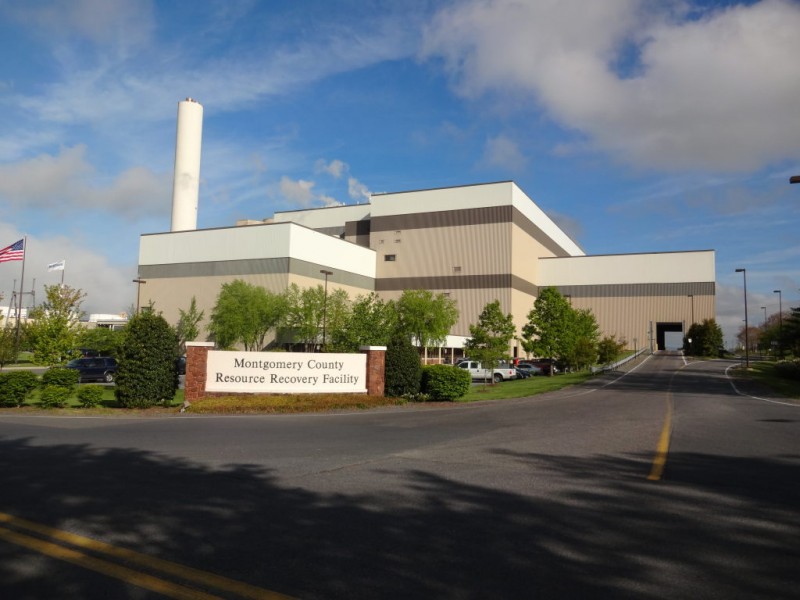
Just as the main event on ‘Big Blue’ is the power plant’, the waste-to-energy facility on my version serves as the big show. Unit trains of specially adapted covered hoppers roll in and out of the facility on a daily basis. Trains up to 26 cars in length can be easily accommodated by the yard at the facility; however, the average train would be around 19 cars as determined by the runaround track at Waldorf.
Inbound trains would be dropped on the receiving (#2) track of the waste-to-energy yard. There is a tail track and runaround (#1) track so that the head-end power can dismount and return to the yard throat to pick up any empties that might be ready to go on the outbound (#3 and #4) tracks. The shop locomotive, which is a GP15-1, would exit the pocket towards the yard throat and pick up the loaded hoppers to be dumped at the main building via the dump track. The shop switcher would likely have to split the load to around 10 cars at a time due to the length of the tail-end of the dump track. After the loads have been dumped, the switcher would set the empties to be picked up when the next train comes in.
Modern Themed Scenery
Thanks to such Pioneers as Pelle Soeborg and Per Laursen, it is a must that I have a modern themed scenery for my layout. To me, it is just as fun to see big modern diesels running past the type of buildings that are typical in towns along the line today as it is operate the railroad as realistically as the modern prototypes. To accomplish this scenic treatment, I will be using several kits from Per’s very own Summit Custom-Cut product line to model the retail scene in Waldorf. I will also be mixing some commercially available kits from Walthers, DPM, Faller and Herpa to create the city scene in downtown La Plata. But where it gets really fun is the fact that I will be building from scratch several buildings such as the Buffalo Wild Wings and Holiday Inn Express in La Plata; and, the modern custom homes on the outskirts of town.
As for materials, I will use a foam base and build up (or down) in layers. Foam is lightweight and can be shaped very easily. The layout will be stuck in a perpetual spring season; therefore, there will be plenty of green in the form of grasses, bushes and trees.
Now that I have committed to a plan, I can’t wait to share my experience in constructing the layout with you. Sometimes, half the fun is the journey; and, I know that many skills (and my patience) will be tested along the way!
UPDATE: An idol mind is a dangerous thing!!! My ‘commitment’ is short lived as I am toying around with an alternative plan that features a continuous run option. Stay tuned . . .

 MDRAIL